How Casino Stories Meet Trảng Bom’s Daily Rhythms
Casino stories in Trảng Bom can borrow the texture of daily routines. Learn to read their language and setting without mistaking a scene for local evidence.

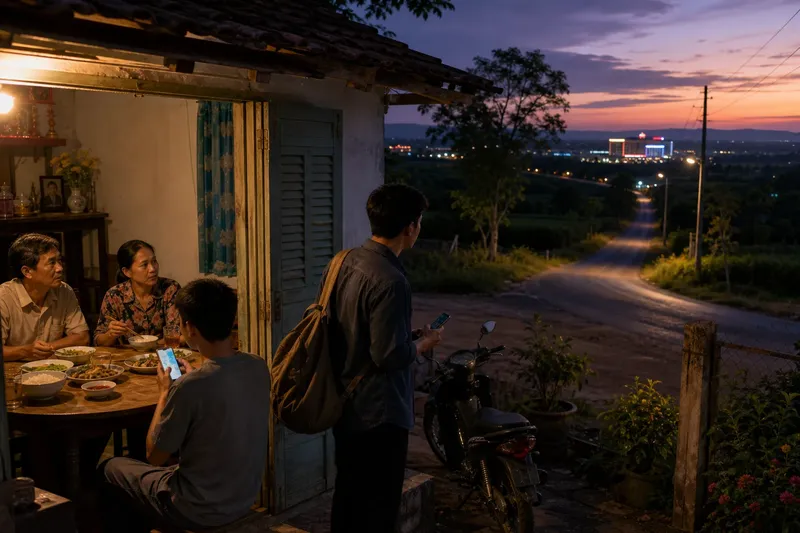
A shopkeeper stacks stools as a neighbour turns towards home; somewhere in an invented casino story, that familiar evening might lead to a private game. Casino stories in Trảng Bom can use such everyday details to make a scene feel grounded, but the details do not tell us how residents actually spend their evenings.
Their interest lies in how they arrange a place on the page: which routines matter, whose voice describes them and what the story leaves outside its frame. Reading that arrangement closely is different from treating it as a portrait of the town.
Place as narrative material
A market closing, a family meal or the last customers leaving a roadside café can give a scene a local rhythm. A writer might use those moments to build atmosphere or bring a character to a decision.
Think of setting as a tablecloth: it gives the scene a surface and a mood, but it does not tell you what everyone in the room believes. The ordinary detail helps locate the story; it cannot, by itself, support a claim about shared local habits.
Labels and their speakers
Words such as “hidden”, “rural” and “local” do more than point to a setting. “Hidden” hints at secrecy, while “local” can imply that a whole community knows or agrees. Those implications belong to the speaker unless the account gives a sound basis for extending them.
Keep track of who is speaking: a character, narrator, journalist or community representative may use the same word with different authority. Reporting a character’s description faithfully is not the same as adopting it as a fact about Trảng Bom.
What the frame excludes
A casino story may centre on a worker, a family argument or a friendship under strain. That focus shapes the reader’s attention, while leaving other people and interpretations beyond the scene.
Look for whose point of view guides the account and whose is missing. If the story follows one character, describe that character’s experience; do not stretch it into a claim about households or neighbourhoods as a whole.
A scene under scrutiny
Say you are reading an invented story set in Trảng Bom. A character finishes work, stops at a roadside café and receives an invitation to join a private card game. The sequence tells you what happens to that character in the story; it does not establish that the café hosts games or that local workers commonly receive such invitations.
Now imagine the narrator calls the game “a village secret”. That phrase suggests shared knowledge, but the scene has not shown who knows about it or how widely. You can discuss the phrase as the narrator’s framing without assigning it to Trảng Bom’s residents.
Questions readers ask?
Is the account fiction or reporting?
Check how the work presents itself and what context accompanies it. If its status is unclear, describe the events as claims made by the text, not as confirmed events in Trảng Bom.
Whose routine is shown?
Identify the character whose work, journey or family life shapes the scene. If the account offers only that viewpoint, keep your description at that scale rather than speaking for residents generally.
What does “local” refer to?
Look for a named place, group or clearly defined scope behind the word. If none is given, avoid repeating “local” as though it expresses a shared view.
Does repetition establish a pattern?
A recurring motif in a story is evidence of the story’s design, not automatically of a real-world pattern. If the text gives no independent basis for a broader claim, describe it as a narrative theme.
Careful public wording
Specific phrasing lets a review or local discussion stay vivid without making the story speak for real neighbours. Use the passage’s details, then make the scope of each claim clear.
- If the work identifies itself as fiction, call the scene fictional; if its status is unclear, say the text does not establish whether it is factual.
- If a character describes a game, attribute the description to that character; if the narrator makes the claim, attribute it to the narrator.
- If the story names a street or landmark, say it places the scene there; if it offers no further basis, do not treat the location as confirmation.
- If the account follows one household, describe that household’s perspective; if other views are absent, do not call it community agreement.
- If “village secret” appears, identify it as the story’s wording; if shared knowledge is not established, do not use it as a factual label.
- If the passage describes one evening, keep your claim tied to that scene; if repetition is not established, do not call it an ongoing local pattern.
These distinctions suit a book discussion, review or local commentary, where a vivid phrase can travel beyond its original context. They preserve what the story invites readers to notice while keeping its assumptions attached to the voice that made them.
Reading the local texture
Casino stories in Trảng Bom can make an evening’s pace, work obligations or private choices part of their narrative texture. Those details may shape a compelling account of place, but they are not a substitute for knowing how varied residents’ lives are.
When a scene feels convincing, ask what it actually establishes: a character’s hour, a routine within the plot, or a wider assertion that needs support beyond the story. That small distinction makes room for close reading without turning a fictional setting into a claim about the people who live there.